
A few days ago, I wrote about how resuming badminton every morning has been making me a better trader. At the time, I described it mostly from experience - better focus, cleaner execution, calmer reactions, less doomscrolling, more emotional stability.
But the more I read, the more I’m convinced there’s a neurological explanation behind what I’ve been feeling.
This isn’t motivational fluff. There’s real research showing that short bursts of physical movement can significantly improve cognitive performance - the exact kind of performance trading demands.
What 20 Minutes of Movement Does to Your Brain
There’s a widely shared comparison in neuroscience showing brain activity after sitting quietly versus after a 20-minute walk. The difference is visible. After movement, brain regions associated with executive function, attention control, and decision-making show markedly increased activation.
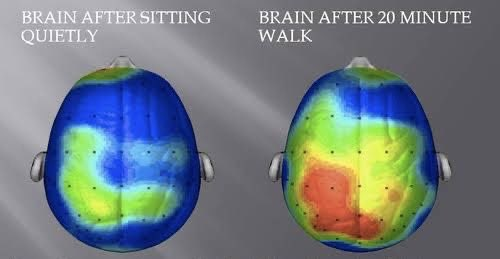
You don’t need to interpret imaging scans to understand the implication. Physical movement increases blood flow to the brain, enhances oxygen delivery, and stimulates neurotransmitters like dopamine and norepinephrine - chemicals directly linked to alertness, motivation, and focus.
In simple terms, movement primes your brain for performance.
When I wake up and go straight to badminton, I’m not just exercising. I’m shifting my brain from passive consumption mode into active engagement mode before I ever look at a chart.
That might explain why trading sessions lately feel sharper.
Competitive Gamers Are Already Using This
What made this click even more was seeing research discussed in competitive gaming circles. A study on gamers found that just 30 minutes of cardio before playing led to significant improvements in reaction time, visual memory, and speed-accuracy balance. The reported effect sizes were above 1.0 - which in research terms is massive.
Think about that.
Professional gamers, whose edge depends on milliseconds and precise execution under pressure, treat cardio like a performance enhancer.
Trading isn’t very different. You are constantly processing visual information, updating probabilities, reacting to price movement, and suppressing emotional impulses. That is cognitive sport. It may not look athletic, but neurologically, it demands the same precision.
When I compare my recent trading sessions to periods where I started my mornings scrolling in bed, the difference is obvious. On days I move first, I react faster and hesitate less. My mind feels quieter but more alert.
Trading Is a Reaction Game Disguised as Analysis
Most traders believe their edge lies in better analysis. But once the market opens, analysis takes a back seat to execution.
Live trading requires real-time pattern recognition, rapid risk assessment, disciplined exits, and emotional control. If your attention drifts, you miss context. If you’re cognitively fatigued, you size poorly or overtrade. If your nervous system is overstimulated, you become reactive instead of deliberate.
Decision fatigue research consistently shows that as cognitive resources deplete, impulse control drops and risk-taking becomes less rational. That’s dangerous in markets.
Looking back, when I wasn’t playing sports and my mornings started with 30–40 minutes of phone use, I was training distraction before I even opened my trading platform. It’s unrealistic to expect elite focus after conditioning your brain for fragmentation.
Badminton has quietly reversed that.
The Morning Shift That Changed Everything
When I play for an hour, intensely and competitively, something subtle but powerful happens. I’m fully present. There’s no scrolling, no market noise, no external validation loops. Just footwork, timing, breath, and instinct.
By the time I sit down to trade, I feel neurologically warmed up. My baseline stress is lower. My reactions are quicker. My attention span is longer. Losses don’t spike my heart rate the same way. Wins don’t inflate my ego as quickly.
That shift alone changes risk management.
I’ve noticed that I cut losers more cleanly. I don’t chase moves out of impatience. I don’t increase size impulsively after a good morning. The process feels smoother - not because I changed strategy, but because I changed state.
And state drives performance more than we admit.
This Is the Missing Layer in Trading Performance
We obsess over optimizing charts, indicators, and setups. Very few traders optimize their nervous system.
Elite athletes warm up before competition. They activate their body and brain before performance. It would be absurd for a sprinter to roll out of bed and immediately race at full intensity.
Yet traders expect their brain to perform at peak levels minutes after waking up.
If 20–30 minutes of movement can measurably improve reaction time and visual processing in gamers, why wouldn’t it improve trade execution in markets?
The performance bottleneck is often not strategy. It’s cognitive readiness.
Track It Like a Variable
The logical next step is measurement.
If you’re serious about trading, you shouldn’t just track entries and exits. You should track state. Did you exercise? How did you sleep? How focused did you feel? How many impulse trades did you take?
Patterns will emerge.
You may discover that your best P&L days correlate with structured mornings. You may notice that your worst drawdowns happen on days of low sleep and no movement.
That’s not motivational advice. That’s performance data.
This is exactly the direction we’re building toward with ASTRA - not just trade journaling, but deeper behavioral and physiological tracking layered on top of performance data. Because trading doesn’t happen in isolation from your body and mind. Soon, we’ll be integrating inputs around routine, focus, and behavioral patterns so traders can see how their state directly impacts outcomes.
Trading is not just financial. It’s physiological and psychological.
Badminton didn’t magically make me smarter.
It made me sharper.
And in a game where milliseconds, focus, and emotional control matter, that might be the real edge.
Check Out ASTRA